Tuesday, 10 November 2015

Hips-ta-ta.

Everybody assumes that coming to Russia to learn the language is a walk in the park for me considering I am half-russian and my mother speaks Russian at home. However, we hugely underestimate the percentage of language and cultural references that we automatically learn from school and everyday life outside the home. There are huge gaps in my vocabulary - different kinds of meat, for example, as my parents are vegetarians - and slang of the "younger" generation presents me with words I have definitely never come across before. 'Hips-ta-ta' is a prime example. What does it mean? It means 'hipster'.

However, my flatmates have been more than helpful and trying to catch me up to speed and I can now (at least, kind of) sustain a one-on-one conversation in Russian so I do have some hope of making friends. At least I might then be able to ask some of the burning questions on my mind that have sprung up from various cultural differences I have noticed.

The metro here is quite different to the tube in London. Firstly it is very, very far underground because Peter the Great decided to build his city on a swamp, and so the metro needed to be built with the slightest chance that it might not sink. After your five minute journey on the escalator down to the metro you normally arrive in a wide, very open hall with options of going to the platform on the right or left hand side, depending on which direction you need to go in. In this hall (note - not on the platforms) are benches placed all along the walls and without fail they are always many people sat chatting with friends, reading books or sat having a cup of tea. My question is WHY? The trains are unbelievably frequent - I don't think I've ever waited more than one min for a train to arrive - and I can think of nicer places to sit and read with a cup of tea. Or maybe the excitement of a train arriving and disposing of load of people who rush past in a race to be the first up the escalator creates an adrenaline rush for some that I simply cannot understand.

Also metro related; at the bottom of every escalator is a woman (normally mid 40's/50's) sat in a cramped glass box, looking like she would be anywhere else but there, surrounded by a couple screens displaying images of the escalators she is already sitting next to. WHY? What is her purpose? WHAT was in her job description? I have never seen them leave this mysterious box or even stand up from the chair they are sitting in.

Unsurprisingly, many of the films shown in cinemas here are not originally Russian films. Normally, when showing a film to a foreign audience, you have two options here: keeping the film in the original language and adding subtitles or dubbing (re-recording the actors' voices in the foreign language). Russians have managed to come up with a third option. Nor does it involve adding subtitles or really dubbing (in the sense of the word) but instead they have decided to simply add another voice (the same one for the entirety of the film) that translates what is being said over the top of the film a couple seconds after the actor on screen. I call it on-screen, pre-recorded, cinematic interpretation. Surely this isn't the solution? It just makes for rather superficial, detached viewing of some very beautiful, touching films.
A nice thing about many cinemas here, however, is allocated seating. The earlier you buy your tickets, the better seats you have (you can choose them or leave it in the capable hands of the cashier) thus eliminating the worry of arriving late and leaving with a sore neck from being stuck on the front row and having to crane your head upwards.

In the world of Russian gastronomy, entire sections of the dairy aisle are dedicated to an ingredient called 'творог' (pronounced: tvaw-rug), which people generally translate as 'cottage cheese', although I would say the cottage cheese we know (in England and in Canada) is closer to a lumpy yogurt than the slightly moist, crumbly, dairy product sold in the shops here. Coming from a culture where we are taught to limit dairy intake, I find it hard to understand the obsession with it here. My flatmates swear by it and one will often eat a big bowl full after going to the gym, claiming that it's packed full of protein.
Having witnessed two elderly Russian woman arguing over the best brand to buy, I followed suite and purchased an elegant, little package found on the bottom section of the творог section. I was confused, yet intrigued. Is it cheese? Is it chocolate? Is it cream? Is it sweet or is it savoury? I made myself a cup of tea and slowly unwrapped the silver foil. What was it? I hear you ask. I STILL DON'T KNOW. It was basically like soft cheese  - similar in texture to what I imagine Philadelphia and Wensleydale if they were mixed together - which is ever-so-slightly sweet and encased in a thin layer of slightly darkened chocolate. My flatmates rage about it - "you can only find it in Russia! it's so great"... Make of it what you will.

Carrying on with the food theme (might as well as I'm sat writing this in one of the best cafe/restaurants in this city - Café Zoom...a bug problem in our flat meant I have to be out of the house for a few hours while the man does his thing so I thought I would treat myself), I find it interesting that restaurants here feel the need to not only have the prices listed in the menu but also the portions sizes (in grams) so you really can calculate value for money. Once you roughly know what 200g of boiled potatoes look like, you can efficiently order enough that will fill you up without having any left over and therefore also means you don't endure the stressful time between ordering and receiving the food wondering if you should have got that extra side of chips.
Another great restaurant-related trend here is the 'столовая' (sta-law-va-ya), which essentially takes your typical school/university canteen, improves the quality of the food somewhat slightly and offers a quick and very cheap way of getting a hot meal at basically any time of day. With a bowl of soup or salad for the equivalent of 35p (72¢ - at today's rates for my Canadian readers) and an entire meal for £1.50, it doesn't cost much more than making it yourself at home. That's assuming that your Russian is good enough to understand what everything is...I'm still making my way out of the pointing and grunting stage.

Over the past six weeks I have probably been to more operas/concerts than my whole three years at Bristol. If you know what to say, concerts can be incredibly cheap for students - a friend of a friend went to buy tickets during the day and, having pleaded with the woman at the box office saying he was a very poor student, he managed to get 4 tickets for the grand total of 200 roubles (£2). (I don't know how much the full-priced tickets were but I would hazard a guess at around 1000 roubles).
Going to all these concerts has only confirmed that while St. Petersburg is very culturally active and forward-thinking, I find that music practice here is still very (overly) traditionally and conservatively taught. As a result, unfortunately the jazz concerts I have been to have left me far from inspired by the musicians who are too concerned about taking their eyes off the page, playing a wrong note or - God forbid - cracking a smile.
I admit, it is maybe a slight exaggeration and maybe I have been spoilt by Thursday evenings at the Gallimaufry in Bristol where the saxophonist plays every note like his life depends on it. The 'jazz' musicians here are definitely technically very able but they just didn't seem to have understand the kind of music they were playing and how it needs to be played... The sheet music is a guide but then you should make it your own and just play from the heart.  The classical music, on the other hand, they can definitely play. When I think of names such as Prokofiev, Shostakovich and Tchaikovsky who all also studied at the same conservatory, whose walls I now grace with my presence, a mixture of fear and excitement manifests itself inside my body... I have a lot to live up to. I'd better get cracking.

Lots of love,

A xx


This is why I love Café Zoom 

Is it sweet? Is it savoury? Who knows.

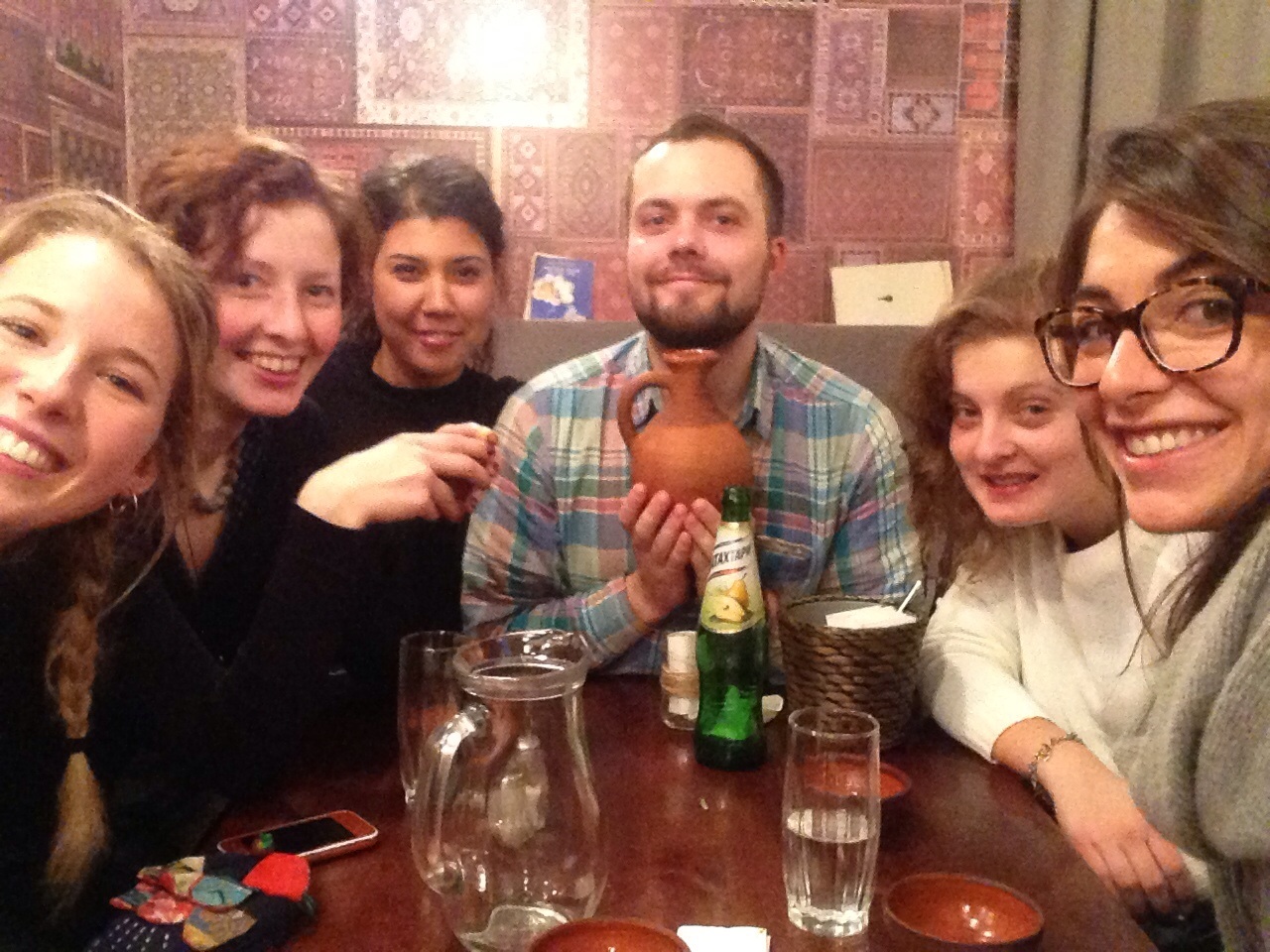
хачапури и вино (khachapuri and grenadine) wine with flatmates and classmates

My flatmate runs cooking classes.
She needs to try out her food at home first.
I don't complain.


Tuesday, 6 October 2015

Buckets and buckets of vodka.

My mum called me today.

"Hello?"
"It's winter."

I mean...if you're own mother doesn't call you to tell you that winter has arrived then who will?

Yes. October has only just started and snow is predicted for tomorrow because I'm in St. Petersburg. And I've got nothing but long, cold dark nights and days ahead of me. So 'A Russian Abroad' has finally arrived to Russia - I guess it's technically just 'A Russian' for now.

I have been here for a grand total of ten days - though it feels like much longer - and I'm slowly adjusting to the way of life. I maybe naïvely thought it would be easier this time, having done it twice before (in Italy and France), but I hugely underestimated the base of linguistic knowledge I had with those countries and the much smaller size of the cities I had moved to.

With a population of over 5 million people, the city is a lot bigger and also more grand and majestic then I expected. The few descriptions I read online prior to my arrival painted it out to be a sweet, quaint, architecturally-beautiful Paris of North-Eastern Europe but it feels much more rich and substantial than that description implies. Within the first hour of arriving, I was driven around on a quick tour of the main attractions and landmarks in St. Petersburg as well as being shown my mum's primary school and the outside of the apartment where she lived as a child during the Soviet Union. It is a part of my family history that had always seemed very distant so finally being able to come and see it for myself connected a thread that I hadn't realised was loose.

The first 24 hours in 'Piter' (as the locals call it) included seeing an opera at the renowned Mariinsky Theatre - a friend of a friend having offered us tickets 15 mins before the show started - and going to a film set to see director Алексей Учитель (Alexei Uchitel) filming a scene for his new film of the incarnation of Tsar Nikolas II on a set which was the most incredible replica of the 'Dormition Cathedral' in the Kremlin in Moscow. (They weren't allowed to film in the church itself). At some point I found myself helping dress the well-known actress Nastassja Kinski (though admittedly I hadn't heard of her...maybe it's a generation thing) in her costume, having run around the warehouse twice trying to figure out which entrance she was coming into. Her costume was the most spectacular creation of Nadya Vassilieva who had also designed and produced exact replicas of military and traditional dress for the actors and extras to wear during the filming. My phone told me it was 2015 and yet I found myself in 1894. The evening also included a reception for potential distributers where guests were greeted with people in military uniforms ladling vodka from silver buckets into guests' beckoning glasses. Snacks were served before going to see the filming and on returning for dinner, the tables had been covered in 50ml shot glasses full of vodka in case we hadn't had enough before and needed help getting through dinner. Hello Russia.

In the first few days I rather surprisingly found myself often making comparisons with my experience in China last summer. I had the same feeling of an eastern, previously-communist society (I know China is technically still communist but the inequality and capitalism present there suggests otherwise) developing and expanding on a big scale to match a high population with huge western influences. Big shopping malls similar in style to those I saw in China highlighting western products with considerably higher price tags. However, over the last few days I have realised that the blatant inequality stemming from a surge of "new" money was much more noticeable in China then it is here - although I have heard that it is a different story in Moscow.

And so summer is well and truly over. I'm juggling two hours of Russian lessons a day as well as lessons at the St. Petersburg Music Conservatory - basically trying to make sense of the ramblings and passionate outbursts of my piano teacher, Ekaterina Murina, who has been teaching at the conservatory since 1964 (!!) and is very very "Russian".

For now though, unfortunately my Russian homework really won't wait any longer...more in my next post I promise - if I can sustain a conversation in Russian for more than 60 seconds you will be the first to know.

До скорого,

xxx

Panorama of Mariinsky Theatre

Opera no. 1
Welcome.

When in Russia...


The dress.

The director speaking to distributors. 

The set

Mariinksy before opera no. 2


Thursday, 16 April 2015

Berlino - why we NEED to travel.

I've just learnt that France is also known as L'Hexagone. Why? If you connect its furthest points together they make the shape of a hexagon... You really do learn something new every day.

It's 3am and I'm half-way through an essay about the reasons for the fall in the birthrate in Italy which is asking me to relate to my own experiences in the country. Stuck for inspiration (surprise surprise - the Italian department is known for often providing inspiring essay topics such as whether or not a pope should be allowed to go on big brother), I decided to look over my blog posts of what is now a distant experience in order to try and trigger a sudden 600-word surge of genius.

And here we are. I've now re-read the majority of my blog posts, corrected a couple typos and decided I need to write at least a monthly post. Not ideal timing considering an unbelievable amount of deadlines and exams looming which now feel like the be all and end all but which, undoubtedly, in a couple years times will feel as distant as the butterflies I felt when embarking on my Erasmus adventure.

For lack of recent adventures to talk about (unless you count an exciting weekend away in Leicester) I must resort to talking about thinking about past adventures - but fear not...fingers crossed I will find myself in Berlin and Cologne in a few weeks time so the next blog post will actually be about a Russian abroad.

I did come to my senses and get to back work after this brief transgression so I'm now finishing writing this post while on the 7 hour bus ride from Berlin to Cologne.

I recently read an article on The Guardian online entitled 'Why we travel'. Following a relatively recent trend in travel articles highlighting the importance of experiencing other cultures and societies, it highlighted a couple aspects of traveling which I had never thought of before. Although we already know the growing importance of multi-cultural understanding, what this means practicality is less often noted. It creates an invaluable open-mindedness; an open-mindedness to ambiguities and multiple meanings actions and objects can have. This in turn all comes down to a change in the way we think.

Jonah Lehrer (the writer) interestingly points out our 'basic human desire' to travel as a migratory species. It seems that the importance does not lie in our final destination or the type of holiday we opt for but the mere fact of putting distance between ourselves and where we live. He elaborates on this idea by explaining a change in the way we think about things to seem further away. Further away from the problem and we can think further outside the box and our imagination is less constricted by the confines by associations which surround us in a familiar environment. Especially useful when solving particular problems, this also allows to exercise our brains in a different way meaning we return with a refreshed cognition and less restricted imagination. He comments that, ironically, though people go on holiday to 'escape' troubles and stresses at home, they should actually be using the distance to focus on them, taking advantage of the change in our thinking process that we experience.

Relating to this more personally (and from an artistic point of view), I do undoubtedly become mentally stuck when I've stayed in one place for an over-extended period of time. This does not mean I'm one to go swanning off on city breaks and beach holidays at every opportunity - even an overnight trip to Birmingham would do the trick - but it does mean a constant need for varying stimuli in my surrounding environment. Even after a few days in Berlin I have found a whole new array of sources of inspiration musically and feel a renewed sense of energy, motivation and determination.

I would say that coming to Berlin was a particularly challenging experience given that I haven't been to a country where I don't actually speak the language (apart from vague remnants from GCSE) in a while and I've only been to Germany once as a child so it's a culture and society relatively foreign to me. I weirdly felt slightly nervous trying to find the train which would take me from the airport into the city, although I do appreciate that nearly everyone speaks English to some degree so is was by no means the same feeling as arriving in China on my own last year! The main aspect for me is figuring out the new way that people relate to each other - every society is different and I would never want to comes across as rude or ignorant.

Though I was only there for three whole days with lots of university work and a couple administrative things to do in Berlin, I was still hugely touched by the sense of need for creativity and openness - a quality that Berlin is known for and attracts thousands of twenty-somethings to the city every year. While Bristol is arguably the most culturally stimulating and progressive british city I still find it, at times, slightly conservative in terms of a certain style of being culturally progressive being the one deemed to be the most interesting one. The 'berliners' seem much more open-minded and it really is a case of anything goes. Yet, this doesn't necessarily mean actual talent is sacrificed. The concentration of musical talent is extraordinary and the willingness to collaborate with fellow musicians in order to develop as a musician individually is strongly rooted in the culture. Sundays at Mauerpark was a wonderful experience with countless buskers sharing a variety of music. Friends were explaining how musicians will get there at 7 in order to secure the best busking spot for the day and sums in the region of 400 - 500 € can be earned in just one day!

I found it interesting that a capital city of such a prosperous country is actually one of the cheaper places to live in Germany and also isn't a city that would immediately come to mind when thinking about the most beautiful cities in Europe. The most characteristic element of Berlin's skyline is a tower similar to the radio tower in Shanghai. The beauty reveals itself in a different form and much closer to the ground in the art and music which lines the streets and fill the buildings of the city. East side gallery and multiple legal and illegal graffiti spots accompanied by people bringing amps, microphones and guitars with them for an afternoon in the park depicts a less commonly found beauty. It will be interesting to see how Cologne, the 4th largest city in Berlin, compares...

Vielen Dank for reading,

xx


'French Dom' 

Obligatory Brandenburg Gate Picture


East Side Gallery


Music in the park


Thursday, 5 February 2015

An encounter with a fellow Russian Abroad.

A post to celebrate reaching 2000 views! I sincerely thank each and every one of you for taking time to read my posts. May my ramblings and incoherent observations have filled revision breaks (as this post is doing for me now) and contributed to highly anticipated bedtime reading.

In the awkward few days between Christmas and New Year when no one if ever sure exactly what they are supposed to be doing, I was lucky enough to be able to meet Count Nikolai Tolstoy while assisting with filming for a Russian documentary. Relation to the great Leo Tolstoy of War and Peace, although he has resided in England all his life, he provided a surprising but reassuring pro-Russia stance (and subtlety pro-Putin stance) which the western papers seem to savagely try to prevent with an overall policy of hostility to Russia. In light of recent events in Paris, it was also interesting to hear him speak about a censoring problem he encountered with the British government - a place where we maybe take freedom of speech and of the press for granted:

Tolstoy wrote a book called Victims of Yalta about the fate of the Russians found in Western Europe in 1945 when the war ended of whom about 2 million were handed back to Stalin by the British and Americans, and then were inevitably killed or died in Gulag camps. He was the first person to write about this and followed with a second book in which he described his realisation that the Prime Minister at the time Harold Macmillan was the person chiefly responsible. Court action followed (sparked by Lord Aldington - an accused accomplice) and Tolstoy was tried for liable action; his phone was bugged and he was then fined £1.5 million (a sum three times more than any other up to that point in British legal history) but only eventually ended up paying £57,000. The censorship was eventually condemned by the European Court of Human Rights but it took 12 years altogether with the trial finally ending in 2000. 

Another book he later wrote titled The Minister and the Massacres was also censored in every single library in Britain - the libraries were all ordered to remove the book (although some did refuse). Interestingly, it happened in 1998 which was exactly 200 years since the last book had been censored in Britain - Thomas Pain's The Rights of Man. Tolstoy then explained that he was preparing himself to go through it again, given that he received permission from Yeltsin (after the fall of the Sovietv Union) to look through secret archives in Russia and had photocopied them all meaning he now has more information about exactly what happened. As a result he is in the process of writing a book to really show what happened in a way 'the british government will not like...and they will probably get up to the same mischief.' 

It seems there is just as much censorship if you touch something sensitive in Britain as there might be in Russia. 

Food for thought.

I'm unsure of how to link my remaining thoughts into a coherent piece in which each flows effortlessly into the other - a sure-fire high-scorer in an exam situation - so I will number them and hope that you don't feel cheated every time my thought comes to a clumsy, abrupt halt.

1. A couple weeks ago (as a self-confessed muso) I went to a music research seminar about communication in music and what exactly it means to 'communicate through music.' After the presentation of the basic research that had been conducted up until that point among students at the Guildhall School of Music and Drama, a conclusion was made that music had to make the listener/audience feel something and the way to accomplish that is essentially for the performer to know and understand the music as thoroughly as possible and then be able to portray that.

Thinking about how music is enjoyed in other cultures, for example, as a way to bring members of the community together singing traditional songs and dancing to traditional music, or to come up with new ways of playing music and new types of music to play, the whole concept of a westernised classical concert suddenly seemed completely and utterly absurd. Is the most enjoyable way to enjoy music really to sit in stiff chairs with limited leg room while trying not to cough or rustle the pages of your program which you read when your mind begins to wander or.... god forbid.... clap in the wrong place? Wouldn't it be more enjoyable to be surrounded by the musicians or to be able to hum/sing (depending on how confident you are) along to our favourite parts without looking like the local crazy person who somehow managed to blag their way in through the front door?

Tell me I'm living in a dream world trying to rattle social norms which have been around for years but music is a wonderful medium in which to bring people together whether communities, friends, families or strangers, and it is a unique language which can be understood by all. Why do we then feel the need to educate ourselves within the constrains of a hard wooden chair and making sure to keep sufficient room between us and the stranger providing us with the music. How much can someone really communicate to someone sat metres away with their head buried in pages after pages of sheet music and half the sound being blocked by a music stand? Music is an art for sharing: if you want to join in... play along, sing, dance, smile, laugh, and cry but having a pained look on your face after 60 minutes on a hard chair is not what I want to spend £10 on.

2. After a article on the front page of the Epigram (the Bristol University student newspaper) (December) and a protest organised by a 3rd year demonstrating growing feelings of irritation and exasperation among the student body fuelled by the university's apparent lack of sincerity and candor when it comes to spending, I discovered some surprising truths about 'senior management' at the university, which made me reflect on what I value the most in terms of education and what it's really worth.

With a vice-chancellor who, at a UUK (Universities UK) Conference, has already shown to be looking towards £12,000 fees, there seems to be less light and more ££ at the end of this tunnel. England is attached to a country where higher education is free for residents and positioned next to countries where it costs mere hundreds a year...one does have to wonder why higher education seems to be valued so lowly in England....or highly from a financial perspective. I have already ranted (in previous blog posts) about the lack of organisation I found yet tried to embrace at the University of Bologna (the oldest university in western Europe) which I had thought would have had enough experience to know how to effectively run such an establishment, however, I now wonder whether I completely missed the point of something they have kept sight of all along. The learning and sharing of ideas and opinions in a free environment, in a way that might develop and nurture a more curious and ambitious generation of intelligent and honest people.

3. I miss China. Known for being quite nostalgic at times, a glance over photos I took and receiving a couple messages from people I met there have made me really miss it. Especially the people and the food. People that were willing to talk even though they couldn't say a word in english and ignored the fact that my mandarin vocabulary consisted of ''I'm english and I'm a student' and the fearless noodle lady who managed to make something delicious which I have tried but failed to replicate on many occasions. With certain parts completely unaffected by western tastes, sticking to traditions and ways of life that they know and that have been passed down through generations, my £4.50 bubble tea half filled with ice from a shop on park street doesn't quite give me the same buzz.

(Literally - the one in China was full of chemicals I sure..)

That's everything for now.

I wish you all a very happy February,

A xx

Paris always makes everything better!


The man himself... (Tolstoy)


Thursday, 16 October 2014

Squatting is the undoubtedly most comfortable way to sit.

Recently I have been regularly asked the question 'what on earth where you doing in China?' much more than I had anticipated. Having applied for the three week Chinese language and culture program completely on a whim without really giving it a second thought, two months later I received an email stating that I had been given a place on the mandarin and Chinese culture course at Nanjing University, China. Flights booked within the seven day deadline, I had now committed myself to a 40 hour mandarin course with people I had never met in a country that I had never even thought about visiting.

When travelling and visiting new places, I much prefer to spend extended periods of time in one area in order to take in and understand as much about the people and culture as possible. Naturally, one can not do this with every place in the world in a lifetime and so I ended up limiting my preferred travel destinations to European countries. China had always been a completely strange and foreign land and I was happy keeping it that way.

I didn't expect to enjoy the trip so much. Well I didn't really know what to expect but I definitely did not expect wanting to extend my stay for as long as possible at the end (and that's not just because I wanted to have as much noodles and bubble tea as possible). In a city where the sound of the ice-cream van is really the street cleaning truck, where it's acceptable to sleep at any time of day on any surface and squatting is apparently the most comfortable way to sit (I still fall backwards every time I try), I slowly started to appreciate and really enjoy this new culture that I found myself in.

There is a beauty to the Chinese language that I had never appreciated or understood until I was lucky enough to spend these three weeks intensely studying the language and Chinese culture at Nanjing University. The language is simply structured without unnecessary changing of verb endings and it uses only words that are absolutely vital to the meaning of the phrase. I was won over by traditional Chinese philosophy, which points to the heart being able to think as well as the mind, although the debates during the lessons were intense with medics never ceasing to use science to prove otherwise and our lecturer suggesting that science is just another religion, which sparked even more discussions!
For a country with such a long history, it was sad to see and feel how much of it had been destroyed. Their "oldest" temples were buildings that had been rebuilt during the 20th century in tourist areas where we saw the expected authentic Chinese architecture which in actual fact had the feeling of a film set and had lost the 'sense' of history you often find when, for example, walking into an old church or castle in Europe.

I felt we were either treated like royalty or aliens. Outside of the olympics, which started while we were there, we were some of very few tourists, which resulted in constant stares (particularly at our height) and requests for photographs together - it was amazing to see that taking a photo with someone could make them so happy and excited. It's also hard to appreciate just how much people there are cut off from the western world - though attempts to show otherwise didn't go unnoticed with an abundance of western style shopping departments and brands. When we asked our favourite noodle lady to take a photo of us it seemed like she had never held a camera in her life...and this resulted in a very, very, very close-up picture of our faces.

The sheer number of people was also incredible. If you consider that London has a population of 8.5 million, Nanjing (which is just one of a group of big cities in China) has a population which matches that, not including 'urban' areas. So many people meant so many vehicles on very wide roads and with all their crazy driving - criss-crossing lanes and fitting entire families on one scooter - we still never saw a single accident!

Regretfully, my 40-hour mandarin course didn't mean that I was able to really converse with local people so I couldn't get a real sense of how it is to live in China without western influences, and anyone that could speak english well enough to explain to me had been educated in 'the West' so their view was slightly obscured to those who had never left the country and who, I feel, would have given a more realistic picture of daily life.

Back in the UK, I'm surprised to realise I really miss China. Upon my return I would hear people speaking mandarin and feel like I could pick up the odd words and at least understand the structure of the language while my stomach would be begging me for one more bubble tea and noodle lunch from our favourite street food lady. Maybe I'll be back sooner than I thought.

Unexplained abundance of watermelons on every corner

Word of advice: approach this beverage step by step


Buddhist incense

A man transfixed by his kite 


Two types of Chinese dumplings - the bigger ones are often eaten for breakfast

So so many lights

Outdoor dining

Casual corner store snack


Sunday, 20 July 2014

Life Goes On

Three days before my 21st birthday and I present to you another apologetic introduction for another late blog post which has actually been written in my mind for a while now but for which I hadn't found time to sit down and transfer to a medium that can be easily accessed by everybody else. The ends of events and periods in our life are always the busiest times as you suddenly realise that the finish line is fast approaching and yet you don't feel that you've done everything you wanted or needed to do. The title, meant to be the reasoning behind this delay, reflects my current pace of life which is rolling along faster than I would like as I try to profit as much as possible from a few weeks in Canada before running off to China for a month - A Russian Abroad part 3 if you will. From Bristol and Bologna to Canada and China (let's ignore Toulouse for the sake of example) maybe I should continue my traveling alphabetically so the next place I visit needs to begin with a D - an A-Z of A Russian Abroad...we'll see.

There are parts of culture that you really can only really experience by living with and going out with french students: the term 'fatigué' would normally be used as an adjective to describe someone who is tired. I can now never used that word without thinking of my flatmates using it more as an insult to describe someone who is a bit boring and a drag to hang out with - my flatmates would jokingly (I hope) ask me if I was 'fatiguée' that day... Going to a club for an end of year gala evening and seeing professors there with the students until five in the morning was a surreal experience. Don't they have a bedtime? And through exams, deadlines, and a flatmate's friend breaking up with his girlfriend I also discovered that red wine, bread and cheese really is the cure for everything.

Although I left Toulouse 2 weeks ago now and the last 9 months are a blur which could have easily been a dream, some last minutes thoughts have been lingering on my mind. I'm often asked if I feel english considering I've lived in England for most of my life or if I feel russian or canadian. I can definitely relate to english culture and the way of life but in the end of the day I still feel canadian and russian given my close attachments to my roots. However, as a good friend of mine said to me the other day 'sometimes I'd just rather spend my time with english people'. Fair enough. Is it the language, culture or way of talking to people that means that no matter how many interesting foreigners you might meet, at the end of the day, you sometimes just prefer to spend time with people from your own country where you've grown up? Yet even in Canada I find I miss english humour which is often lost on people here and I often have to repeat what I say, tweaking my accent so that people can understand me.

At the end of June I played in a concert just outside of Toulouse in a town called Mazères. I noticed that there were many older people wandering around the streets and then realised that in Toulouse I rarely see them. Toulouse seems to attract the younger generation - students, recent graduates and young families - which fuels the city's constant energy and then, when it gets too much, people leave to see out their twilight years in a peaceful, idyllic, french, countryside town.
Interestingly enough it was while doing research for my french essay about 'l'identité toulousaine' that I fell in love the city - about two weeks before I was due to leave. Quite a change from the indifference I felt towards it when I first arrived and was missing Italy. Talking to so many 'toulousains' meant I realised what a great city it is and the strong relationship people have with the history, culture and youthful dynamic of the city. Better late than never I suppose.

Anyway, life does go on. All good things must come to an end and now is the time to see if all the promises to visit and skype every week hold out. Canada has seen me doing yoga three times a week, cutting down trees, driving a tractor and swimming in the ocean every evening - a complete yet welcome contrast to intense, european city-life - and pre-departure reading about China is due to start any day now. What do I miss the most? Good italian coffee, long lunch breaks, fresh baguettes, italian ice-cream, french cheese and red wine (see above), italian hand gestures, La Garonne (the river in Toulouse), and french paperwork. (The last one is obviously a joke).

A big thank you to people who have read through my Erasmus experience with me - it's been an absolute pleasure.

Lots of love,

xxx 

Testing out my new camera

Spontaneous weekend to Florence and Bologna


Outdoor orchestra concert at Mazères


Friday, 2 May 2014

The Things I've Learnt

Ironically when I find myself the most inspired to write my blog is when I also find myself at my busiest with no time to sit down and share my experiences!

All the same, I'm now temporarily back in Italy with a few spare minutes to share my latest thoughts and experiences with you, all the while being grateful that my Italian hasn't left me since being away and that the city and the people (and the food) are just as great as I remember them. I was finally able to enjoy a truly good coffee after two months of the frenchies' failed attempts to prove that they can rival their neighbours and you can never go wrong with an italian cooking you a decent plate of pasta. Moving out of my house to move into a new apartment in a couple weeks time I found all my old italian notes from when I just arrived to Bologna with things such as "Che ore sono?" (What time is it?) and laughed at the fact I felt I had to write something down which now comes so naturally to me. It's encouraging to see improvement that's for sure - I really used to be so horrendously useless at Italian.

The other day I came across another blog post titled 'The Things We Learn From Strangers' and it reminded me of a flight I took from Texas to London a couple years ago in which I spent six hours chatting to the guy next to me who came from such a completely different background - a young dad of five home-schooled kids who had never left the US. Always (arguably unfairly) skeptical of americans from Texas and having had these views confirmed while waiting to board the plane at the gate I wasn't very enthusiastic when he struck up conversation and started asking question after question about life in Europe but six hours later my mind had been changed and I was left reflecting on his way of life back in the States. As this blog post says, you really can learn something from everyone you meet. Though I have met so many great people during Erasmus (and even before), how many people have I actually kept in touch with after our hour, day, week, or month of being best friends? Honestly, very few... but that doesn't mean I haven't remembered stories they've shared with me, things I've learnt from them or experiences we've enjoyed together.

Last week, my boss invited me to go with her and her husband to a private concert in Toulouse. Never one to say no to a free concert, especially when there's a piano concerto involved, I came along and found myself in the centre of the upper-class, bourgeois bubble of toulousain society. Turns out the concert was sponsored by big companies in Toulouse and so was essentially a lovely example of industry and culture in Toulouse coming together but I questioned whether the majority of the people there really had an interest in classical music or whether they were just there by obligation. Sat opposite the head of Toulouse airport, nearby one of the bosses at airbus and finding myself a few metres away from the new elected mayor of Toulouse during the interval I felt slightly out of place as a student wearing my denim jacket and trainers but certainly enjoyed observing the beautiful manicured wifes that they all had on their arms and realising that all the really important men seem to have incredibly big noses. Is that just a coincidence? My boss not really being one for cosying up to people and engaging in small talk about the weather and how Fabienne* and Jacques* from a dinner party months ago are doing, we greatly enjoyed people-watching from a distance while making the move to secure prime central seats during the interval.

A couple days later I was brought back to earth when I went to another concert of my own accord and was met with crowds of people outside and a completely locked concert hall. Ten minutes of waiting and listening to surrounding frenchies getting angrier and angrier about the lack of information, a window on the second floor opens and a woman pops her head out to explain that protestors somehow got into the hall during the day, haven't let the orchestra rehearse and are unwilling to move or even negotiate in order to facilitate the running of the concert. How bizarre. The french really do just strike or protest whenever and wherever they feel like it.

I recently realised how ridiculously easy it is to make a bit of pocket money teaching english. It's a language that an incredible amount of people want to learn and being a native english speaker means that people will jump at the chance to rack your brains for an hour trying to extract and take in as much of the language as they can. To this end, I decided to complete an online TEFL course so I do feel somewhat qualified to actually teach english even just for a couple hours a week. Some parts of the course involved considering different ways to teach the language in terms of whether to start with grammar, vocabulary, or to get people speaking from day one even without any exposure to the language. It made me think about teaching grammar - or even using grammar that I've learnt for my languages but then receiving the reaction "yeah but no one says that!" Well, why are we learning it then?! So it's 'technically' correct but the majority of the people speaking that language don't say it like that and don't really tend to use it in written language either. Who is this person who has decided that the most common form is the 'incorrect' one or the 'correct' one is the one that no one uses. Surely, the 'correct' way of speaking would be the way to most effectively express yourself in line with the current use and development of the language of the people you are talking to. Rant over.

I'm being summoned to make lunch and I haven't even got round to sharing my excitement for month of fun round 2 which is starting in no less than 29 days....

A la prochaine,

xxx


*insert any typically french names

A private tour of the Toulouse Observatory

Toulouse at it's finest on the first warm evening of the year

The perks of teaching english to children

Easter Sunday brunch in line with typical french traditions