Showing posts with label St. Petersburg. Show all posts

Saturday, 6 May 2017

A Russian beating.

There are some traditions and practices in various cultures, which are very difficult to explain to someone who hasn't had the experience themselves. A Russian banya is no different. "It's just a sauna" people might say... and while it might look similar on first glance, the similarities end there.

A Russian banya is much more humid and so tends to feel hotter. This high heat/high humidity combination is supposedly very good for your health, especially your heart and lungs as well as blood flow and clearing toxins from the body. This is due to the way the room is heated. Stones are heated in a enclosed space, as opposed to the open stones that you see in a Finnish sauna, which allows them to get 3/4 times hotter. Furthermore, water is dumped over the stones and as it evaporates, the пар ('par' - steam) is produced ensuring high humidity - the key element. Being naked is a given, although hats are worn to prevent you from overheating. While going to the sauna in Europe and elsewhere might be considered a luxury, going to a banya is seen as a necessity for health and cleanliness. The tradition of going to a banya dates back centuries - to a time where Russians were much cleaner than their European counterparts! And so going to a banya is essentially not for relaxation but for cleansing, cleaning, scrubbing, purging, purifying and restoring; and a key part of this process is beating yourself or one another with branches generally made from birch or oak. The branches play a vital part in circulating the hot air and as a massage to stimulate extracting toxins from your skin. So people are actually generally quite 'active' as they go between beating themselves, beating others, having tea breaks and scrubbing. Afterwards, people will wish you a "с легкоим паром" ("s loh-kim pa-rom") meaning they hope you had a nice banya experience.

A friend told me about a young couple I recently met planning to move to the dacha they rented full-time for the summer. Having been there myself, the lack of running water crossed my mind and I asked how they would wash during the time they were there. "They have a banya there," was the answer I got, accompanied with a quizzical look for asking such an obvious question. Cleanse in the heat, scrub and dump a fresh bucket of water from the well over your body afterwards and you are good to go. There is no doubt that this centuries-old tradition is just as current as it ever was and, having seen a mother with her very young toddler in the public banya I went to, it is clearly something that is introduced from a very young age. My friend also explained that there are many communal apartments that still don't have bathrooms - and many with bath tubs in the kitchen - and so going to a banya is really without question.


So, still feeling a bit groggy from the winter, my mum was kind enough to invite me to join her for a luxury banya experience for two that she had been given as a present. Having only had one banya experience before, almost a year ago (with a group of friends in a small hut on the side of a small lake), I didn't know what to expect going to a luxury spa in the centre of Moscow.

I certainly didn't expect a very young, handsome male wearing a small towel around his waist to open the door to our private banya complex, complete with a table full of fruits, nuts, nibbles, compot and herbal teas for our 2-hour session. I certainly didn't expect having to be stark naked in front of this young, handsome man - "of course you have to be naked, it's a banya" - as I lay on the sauna bench while he beat us with oak branches (front and back) and scrubbed our skin with a mixture of honey and salt. And I certainly didn't expect the 2-hour session to end with lying on a marble table (still naked) in another room, with unbelievably bright lighting, while he used a hemp-like material to scrub clean - just soap this time - every inch of my rejuvenated and newly-purified skin. So that's how the other half live...I have always wondered.

Although I worry that I lost some of the 'purity' waiting at the bus stop for half an hour as they decided to close off the road just as we got to the stop. Unfortunately a daily occurrence in Moscow, which only adds to the constant heavy traffic, for anyone deemed "important" enough to merit such treatment. All cars are completely stopped and blocked off from the main roads to allow for a swift journey for the brigade of security cars, police cars and the car containing the VIP. This time we waited for a full 20-minutes before we saw the dazzling lights of the vehicles coming towards us in the distance. It is a wonderful excuse for being late to lectures though...

A month later, with no Easter holidays scheduled into our university timetable and a only one day off for May-bank holiday, I decided that a self-assigned holiday wouldn't do anyone any harm and I didn't hesitate to book the first train I could back to St. Petersburg. Nearly six months apart and it felt wonderful to be back - as is often the case, you have more appreciation for a place when you are only there for a restricted amount of time.

A friend mentioned that there was a public banya very close to the flat and I was keen to give it another go. Emphasis here must be made on the word 'public' and on the fact that this place cost 1/26 of the price of the luxury spa...

Mentally preparing myself on the way, I felt excited yet slightly apprehensive as I approached the entrance. No handsome, young males to open the door for me this time and, without the added awkwardness, strolling around naked felt wonderfully liberating and very natural. Trying to act cool as I opened the door to the banya, I quickly scanned the room for the ideal spot. It's safe to say, there are not many places in the world where you open the door to a room full of naked babyshka's wearing hats while beating themselves ferociously with branches. It's a shame that you can't take photos...! First time on my own in a banya and not realising that you are supposed to soak the branch in water before using it in the sauna, I was immediately identified as the novice and my lack of hat and body scrubbing materials only highlighted this. However, I beat myself with my bundle of the brunches the best I could and managed the plunge into the ice-cold pool more than once. On leaving at closing time (11pm) I heard a fellow bather bid a "see you tomorrow" to the woman at the front desk - it seems that for those with the time it is a daily ritual. When it costs £3.99 (CAN$7.05) for a 2-hour session or £1.33 (CAN$2.35) if you come before 5pm, it's hard to find a reason not to. As I made the 5-minute walk home, I felt unbelievably fresh and rejuvenated and vowed to find a local place when I get back to Moscow.
I am pretty much an expert now after all.


Happy bank holidays,

A xx


Coming out of hibernation and taking an afternoon to explore

Stunning beach an hour train ride from St. P 

The extension on the left is where you will find the kitchen and the banya - what more do you need...?

Waking up to a burning sensation on my neck and face from the morning sun - priceless.

All the great Russian Soviet composers seriously vibing and sticking to the rules; no smiling in photographs


Friday, 22 July 2016

Some things never change.


Although I would say that I am a fairly-experienced traveller, that still doesn’t seem to ever prevent my baggage from being overweight, and the threat of paying extra is always a very real worry at the check-in desk. I remember the day I bought my huge, bright purple suitcase, thinking it was wonderful that it was so big as it meant that I would always be able to bring everything I wanted with me…. What a silly mistake that was, and little did I know that at the time. Cue countless memories of dragging its heavy, large bottom behind me as I trudge through airports, train stations and cities just trying to find a place to rest my head. 

This summer was no different. Having stayed a extra week in St. Petersburg to enjoy the city as a tourist before joining my family in Canada, I was completely on my own as the unsympathetic lady at the check-in desk in St. Petersburg said there was no way I was getting on the plane with hand luggage that was twice the weight limit and checked baggage that was already too heavy unless I coughed up £60 worth of my hard-earned roubles. Neither my smile or explanations that I am a poor, travelling musician did anything to soften that well-known Russian scowl. I would not be beaten. Thinking quickly after a frustrated walk around the terminal, I came up with the solution of taking out my heaviest books and hiding them with a lovely-looking old lady (who was so early that she was still waiting for her check-in to open) before returning to the check-in desk and lying though a gritted smile that I had called my mum and she had turned around in the car to come back and take the books. The lady at the desk begrudgingly handed over my ticket and I made the plane with a few minutes to spare. [I thanked the old lady profusely and she looked on bewildered as I tried to cram everything back into my suitcase that would barely close].

Running out of money during my last week in St. Petersburg, I did a search for anything free I could do to fill my time. I enjoyed a wealth of free music festivals the city had to offer but was struck by the difference between what I was experiencing and previous experiences of festivals in the UK. Turns out that Russians don't dance. At all. I do and indeed I did, but even to the liveliest and funnest of music, spotting a tapping foot in the crowd was like searching for a needle in a haystack. They also don't drink or smoke. An outdoor festival in England seems to be a great excuse for people to enjoy beer or Pimm's in the sunshine, often with a cigarette in hand. There was not a drink or cigarette to be seen and the most wild drink available for sale was квас (kvas), a popular drink made out of rye bread and so low in alcohol (around 1%) that it is considered non-alcoholic. Although, this probably explains why they don't dance. 

I decided to spend a week in London catching up with old friends before returning to the west coast of Canada for the summer. Coming from the sad lack of multiculturalism in St. Petersburg (unless you count the swarms of tourists who appear to bath in the endless sunlight of ‘white nights’) I was particularly struck by the beauty of the array of languages and cultures one encounters day-to-day in London. I LOVE that the barman can be Spanish, while another one is Italian and the barista is French. Outside you can meet someone from Prague one minute and an Aussie the next. From the girl from Brussels who met an English boy and decided to stay, to the Italian girl in Pret (A Manger) who gave us sandwiches after closing time to Sheila Anne the Londoner who was born in Pakistan and had unbelievably quick wit. All working in London and all there to embrace the culture, learn the language and enjoy the wonderful choice of activity and opportunities the city has to offer.  Over-excited to finally be in the capital for a descent amount of time, my friend and I explored just about the entire city by foot but this didn't mean I was immune to the usual public transport predicament that tends to happen in cities I am less familiar with. Although not entirely my fault, I accompanied my friend to catch her bus up north - having carefully chosen the train times that would get us to the bus station with plenty of time to spare - and we arrived to the bus station without a hitch only to be informed that we were at the wrong bus station. Ironically, straight after a conversation we had had about growing up and maturing and becoming more sensible and organised. Turns out, some things never change - a cheerful note for the day before I turn 23 on the 23rd.


Happy Summering,

A xxx


'Realism' - an interesting take on modern day society

7am post-dancing walks with friends

The view that steals my heart every time

The iconic beach in the middle of St P that has changed since my mother was a child

And the view very close-up


London walks and London talks


Wednesday, 29 June 2016

Alcohol in breakfast products.

I had to do a Russian literature exam the other day. 

A terrifying prospect, but made somewhat easier by the fact that it was multiple choice and the word for a multiple-choice test in Russian is угадайка (oo-ga-da-i-ka) that derives from the verb угадать (oo-ga-dat) meaning 'to guess'. 
[So to all those at uni that used to moan about having to revise for multiple-choice tests....]  

Although I am reaching the end of my first academic year in Russia, having unexpectedly stayed 6 months longer than planned, cultural differences continue to shock and surprise me. I wonder how long you have to live somewhere before you become fully accustomed to the people and the place. 

On a recent late-night trip to a nearby shop with my flatmate, having stopped in the dairy aisle, I decided to take advantage of his presence by asking him to explain the unknown products there that I still hadn't managed to figure out. 'Kefir' is a pro-biotic, fermented thick milk drink [for first-timers it might seem like sour milk] that I had already been lucky enough to have the opportunity to try on a trip to Moscow with my mother during my early teenage years, however, a bottle between the milk and kefir caught my eye. 

"There's alcohol in that one..", my flatmate joked. 

Turns out it wasn't a joke. Hidden among the most innocent of breakfast products was a type of kefir with the addition of alcohol to really make sure you have a great start to the day. Good morning, Russia. Good morning indeed. 

Coming to the end of my stream of auditions, I have been left needing to make the choice between St. Petersburg and Moscow for my next academic year. People have warned me that moving to the capital after St. Petersburg wouldn’t be easy and the question is whether I’m ready for “real” Russia; those who don’t live in St. Petersburg often claim it isn’t really Russian as it is far too European. [<— Although I beg to differ and I would sometimes even argue that it is not European enough for my liking….but that’s personal taste of course.]

While St. Petersburg values the importance of a work-play balance, Moscow is work, work, work - the pace of life is cranked into full speed and you have no choice but to keep up. Although if you're lucky, you might be able to catch up on sleep during the 90 minutes it takes you to get anywhere around the enormous city (nearly twice the area of London).  

St. Petersburg is by no means small, yet I rarely feel the overwhelming sense of size, which greets you the moment your step outside your front door in Moscow. In St. Petersburg, the high-rises tend to be concentrated around metro stations outside of the centre, which allows me to live in my cosy central bubble without feeling the cluster-phobic effect of the millions living in the city around me. A city where I already have my favourite coffee places and where I can get to anywhere I need to go within 40-60 mins as a lot of the city is (technically) walkable. A city where I can suddenly decide to go to a concert or a play or meet a friend for dinner last-minute and where most restaurants and bars are affordable. Although it is very hard to overlook the weather. Especially when more than 3 hours of daylight during the winter months is optimistic. Prior to moving, everyone warned me about the cold - fine, you buy yourself a good coat - but no one warned me about the lack of sunlight and the huge effect this has on your energy levels. As mammals, my body definitely didn’t understand why it couldn’t just go into permanent hibernation for a couple of months. During the winter, I was never able to get up before 11:30am and I remember coming back from Moscow one morning at around 10am and being shocked that it was still pitch black outside.

Moscow is a city that just feels inherently “Russian” in the sense of size, power and majesty. There is just so much space and so many cars. And there are millions and millions of people (around 17 or 18 million). Towers are spread throughout the centre and complimented by the 10-lane roads that connect them, the space between them only emphasising the power and grandeur that they represent. While others cities tend to have high-rises and towers concentrated in one part of the city - often in the centre - with small roads between them giving you the feeling of being in a maze and with the buildings getting smaller as you get towards the suburbs, here it’s the other way around. 
This, undoubtedly, has an effect on the people living there. Living in Moscow is about working. Socialising seems to be a very much side-lined activity and hard to program outside of work considering the time it takes to get anywhere and the very loose ‘working day’ which can end anywhere between 5 and 11pm. Nice areas to walk around or meet friends for coffee or lunch are limited and are in any case often quite expensive. The slightly better climate means that the 7-day working week can continue, without question, all through the winter. Not a second to waste.  

So a choice needs to be made. Do I let myself get swept up in the rapidly-changing, constantly high pace of life in Moscow or do I stay in the comfort of a city that feels slightly closer to home.

[Or....do I just run away to Italy. A recent stopover there, after a concert in Germany, confirmed that true love never dies. After a brief moment of forgetting the word for ’sun’ and repeating the Russian word over and over again, my brain switched into gear and everything came flooding back. Eating three weeks worth of pasta, pizza and ice-cream accompanied by Aperol and Italian house wine over the few days just about managed to satisfy my cravings.]

For now, though, I going to take full advantage of 23-hour daylight with late-night bike rides, early morning walks followed by yoga and last-minute evening trips to the theatre and maybe the odd glass of wine on a rooftop. 

Winters are for sleeping and summers are for playing.

Lots of love,

Masha xxx

St. Petersburg's surprise summer storms - keeping you on your toes

Late-night, post-theatre river love

Midnight, white night, bike night

Middle of the night sunrise

Popping back to Berlin for a few days, keeping it real and keeping me sane.

Tuesday, 3 May 2016

Living in a city built for cars.

Feeling worse for wear, tired, damp and wedged between a rather large man and a window and with my phone out of battery, I had no option but to endure a twenty minute conversation about the bus we were on. What was the height of the ceiling? Had the bus been made in Russia or in Germany? Did it run on diesel, natural gas or petrol? Did any of the rods running along the ceiling have anything to do with its fuel efficiency? Did the colour of the bus have any correlation with the type of fuel it ran on? On and on he went and managed to drag three complete strangers into the conversation, which he had initially started with the conductor - this time a poor, young girl who clearly wanted nothing to do with it but seemed to have all the answers.

To be honest, any kind of travel in St. Petersburg or Moscow is eventful and not easy to say the least. I have already recounted my difficulties with the metro in Moscow, but the metro is one of a plethora of available options of "public" transport. Unfortunately, in St. Petersburg, there is a general mentality among older generations of 'if you have a car, you use it'. Following the Soviet Times, where owning a car was rare and involved paperwork and months of waiting, welcome to the ultimate time of 'if you've got it, flaunt it.' For a place with a huge amount of people living in it, the city is surprisingly unaccommodating to people! Many roads will have three or four lanes in each direction (car lanes - no bus lanes at all) while people, scooters, and bikes are left to battle it out on the pavement. Not a bike lane in sight in a city that is flat as a pancake. Ironic compared to mountainous Bristol where you find bikers on every corner, sweating up and down the hills in the sun and getting soaked in the rain, often probably questioning their decision to bike that day. Unfortunately, the amount of cars also seems to contribute to a sometimes unpleasant amount of dirt and pollution in the city caused by traffic jams throughout the day. Discovering an amazingly quiet part of the city on the east side of Vasilevsky Island, I realised how pleasant the clean air was and how I had gotten so used to the constant rumble of cars and dirt that I was stunned by the stillness and purity of the bay.

So, the logical option is to take a form of public transport, in order to reduce the number of cars on the road. Brace yourselves. Taking a bus involves a scarily high probability of being swarmed by baboushka's in a rush to get their favourite seat on the bus (I still wonder where all the dedoushka's are) before you get stuck in the traffic caused by no bus lanes and the huge number of cars. Taking a marshroutka (a mix between a bus and a taxi - a minivan that follows a certain route and will pick up and drop up passengers anywhere along that route) involves being confident enough in your knowledge of the city and the language that you know where to get off and can explain that to the driver, who is very rarely Russian himself.

The metro might seem like a viable option, with the guarantee of no traffic jams and a very frequent service but you need to add 10/15 minutes to every journey to allow for the seemingly endless escalator ride in order to reach a depth where it was safe to construct a metro in a city built on swamp land. My flatmate is a huge fan of trams and is often excited by the idea of taking his favourite old tram (often no.6), yet the trams don't offer viable routes through the centre and it is never really clear where I can actually get on.

Going slightly longer distances, such as that between St. Petersburg and Moscow, I often take the night train. The novelty soon wore off unlike the taste of the stale croissant, vacuum-packed salami and curdled yogurt that they serve you for breakfast. I accept that I will never understand the people who feel the need to set their alarms an hour and a half before arriving in order to waste time fussing around in the compartment, hugely reducing the already limited amount of sleep you can manage to get on the 8-hour journey; the best earplugs in the world won't block the snores some people manage to produce.

So I have taken to riding on a ex-flatmate's scooter around the city and I feel like superwomen. The best combination I could find between speed, ease and flexibility... I am worriedly awaiting the day she finds time to stop by and take it back...

Back in England for a week over Easter and I realised how much I miss driving - there is nothing like putting an old CD on full blast (I could only find Green Day and Britney in the car...shame) and driving around in the countryside without another car in sight.

The flight there left me with one question that I still haven't been able to answer: why is it so hard for people to stay seated until the seatbelt sign has been switched off?!

Transport worries aside - the city has transformed from the snow-covered wonderland it was a few months ago. White nights are arriving quicker than I thought and there is something quite magical about having the sun shining nearly 24 hours a day. Four in the morning looks very similar to eleven in the morning as well as eight at night and I am told every day, by friends and acquaintances alike, that the white nights are absolutely spectacular. I can't wait.

Lots of love,

A xx


The quiet spot I found

Writing a 'retro' letter to a friend using ink and a quill in the HUGE main old post office on Pechtamskaya

Chaki the Cat agrees that working is for winter time


Tuesday, 22 March 2016

Sundays don't exist in Russia.

The Big Melt. Back into my daily routine and my days are filled trying to avoid falling clumps of snow and icicles - especially after my mother was kind enough to scare me with a story of someone in Moscow getting killed by a falling icicle...

I realised that all the snow was actually covering a lot of grime and gunk around the city: I learnt this the hard way when I decided that it was time for the first outing on my scooter and arrived to meet my friend for coffee with the back of my legs covered in dirt. But this is a sign that the worst of the winter if over and is accompanied by rapidly increasing daylight hours, not only allow for more time to appreciate my surrounding environment but also mean I have started to come out of hibernation and really take advantage of everything going on in the city; mainly more trips to concerts at the St. Petersburg Philarmonia, which is in the centre of town and has something going on in both halls every day of the week. The Russians are known for playing classical music to a very high standard and the musicians I have met here and concerts I have been to are no exception, and having to get up at 6:30am in order to a secure a practise room - not out of pleasure I can assure you - as arriving later 7:15am means you are out of luck assures me that the next generation will be no different. On Sundays, I normally take the day off, however, last week I thought I would go in to conservatory for a couple hours in the afternoon just to play around. It's a Sunday, I thought. No one will be around on a Sunday, I thought. People will be at home relaxing, going for walks in the sunshine or drinking coffee with friends, I thought. How wrong I was. Just as busy as any other day - if not busier. Then I realised... everything is always open on a Sunday: shops are opens and transport runs with the regularity of any other day. Sundays simply don't exist in Russia.

In terms of composers' music being performed, the 'Greats' are played to an extremely level of precision and discipline, which is of course something to be commended. However, I have been more disappointed by the contemporary music, whether it be classical or popular, coming out of the city. There is a small community of people trying to create original, new music yet there seems to be a huge lack of an audience for it and any interest I have shown, during my lessons, in playing contemporary or modern music has generally been met with confusion and disinterest. A friend was playing in a concert of conservatory students' compositions at the Philarmonia and, still frustrated by the feeling of being too stuck in the past and full of curiosity and hope, I decided to go along. Most people will know and agree that student compositions can be a bit hit-and-miss, pushing some boundaries that aren't necessarily meant to be pushed. However, I was pleasantly surprised and filled with relief by how much I genuinely enjoyed the concert - even if the hall was half full and a number of people left far before the end.

I was particularly struck by the reactions to an electronic, sound design piece involving a string quartet hooked up to microphones and playing very minimal, soft sounds on their open strings, which were then projected into the hall. I was filled with anger as I watched people start to laugh, chat to each other, look at the time and consider having a toilet break. Such close-minded people who laugh at an artist who has the courage and audacity to do something original, interest and different in an otherwise quite stifled, restrained musical environment. Well the composer got people's attention, that's for sure. It reminded me of the reaction people originally had to Stravinsky's Rite of Spring the first time it was performed in Paris. Just don't be so rude!

Unfortunately, this conforms with a close-mindedness - particularly among the older generation but not completely absent among the younger generation - that I am increasingly coming across and can be hard to handle at times. The lack of multi-culturality that is so decisively present in European countries such as England and Germany and, so, the lack of exposure to other ways of doing things and other ways of thinking means that I find people generally more close-minded and more argumentative. Especially among the Soviet generation: all people had a similar quality of life and a steady daily routine in the place where they had always lived. How could they possibly know any different. This came up in conversation today with my flatmates; my flatmate having gone to visit his grandmother outside of the city centre and having been congratulated for having shaved his beard (not that it was particularly long prior to his visit). My other flatmate explained that, to his grandmother, it was a sign of laziness - in Soviet Russia, everybody would work from 8am - 6pm and then would have time in the evening...to shave, of course!

Surprise surprise, I am off to a concert at the Philarmonia...

Lots of love xxx


View from a practise room at 7am


Escape to the dacha round 1


The big hall of the Philarmonia

Escape to the dacha round 2

My new love - Soviet Russia interior design

Moscow welcomed me with open arms


Monday, 28 December 2015

Moscow loving.

'Time flies' 
A phrase technically implying that the time passed felt shorter than it actually was and a phrase that, on the plane home for Christmas, I would appropriately use to describe my last three months in St. Petersburg. However, ironically I also feel like I have lived there for years, much longer than three months at least, and so contradictory to saying that the time has 'flown'. (If only my ability to speak Russian reflected having lived there for years…!)  

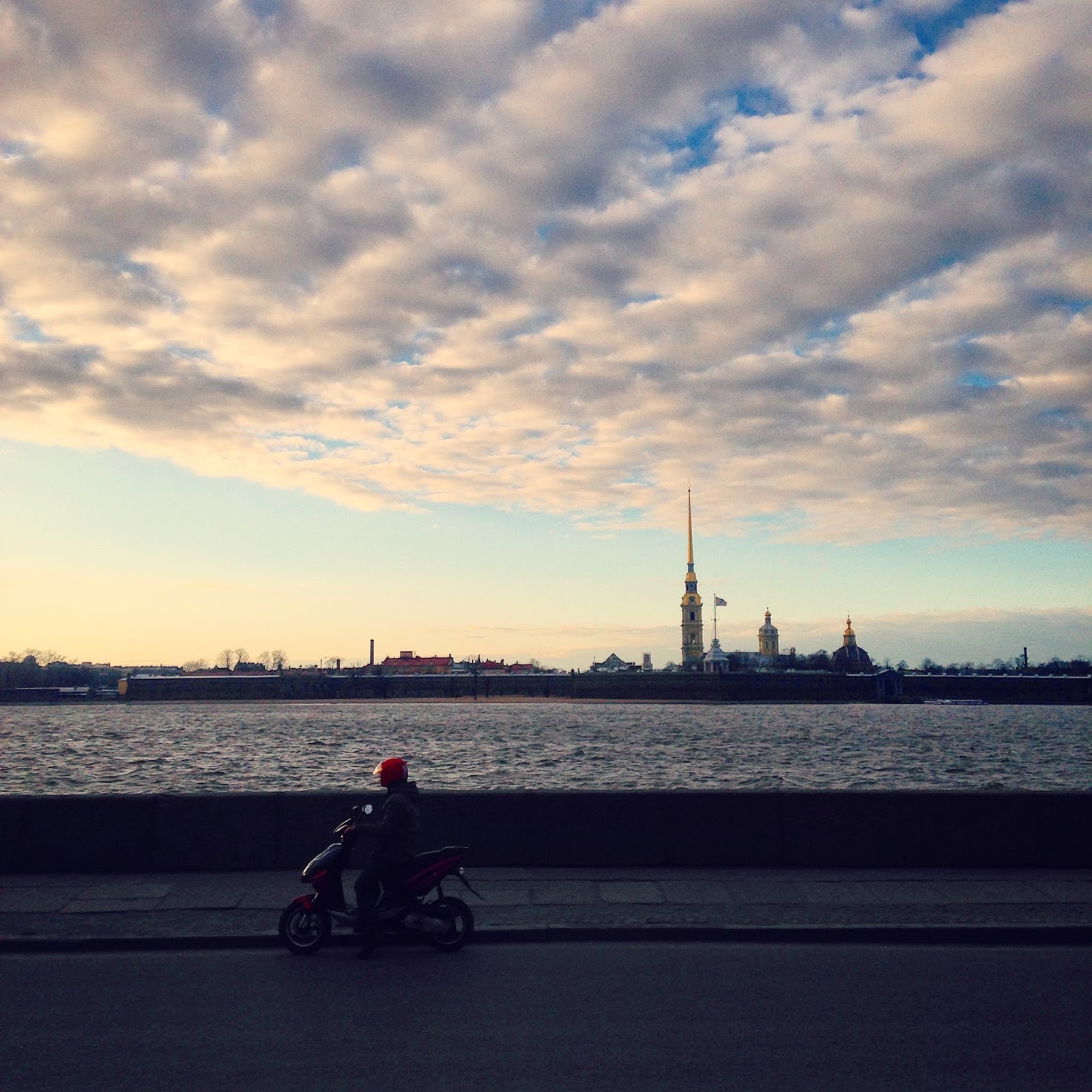
My decision to stay longer than the originally intended three months has been met with many a confused look and questions of why I even came here in the first place and why on earth I like it so much. What’s not to like about a city with lots to see and do, great people and stunning architecture? Lack of affordable fresh fruit and vegetables along with dirty air meaning I have to wash my hair every other day (much more often than the weekly wash I could get away with in the UK) and tiredness as the result of constant darkness I wouldn't say are top of the list for reasons to stay. My father asked me what I wanted for my first dinner back… a plate of fresh vegetables and salad please. Ideally freshly harvested and put straight onto the plate and maybe a tank of fresh air and some sunlight. On a recent trip to Moscow, I saw sun for the first time in weeks and felt like Christmas had come early. I was running around like a small child all day! In answering these questions, I find myself trying to explain many beautiful elements of Russian culture and characteristics of Russian people which we don’t hear about in Western Europe. The stereotype of the stern-looking Russian has been challenged by the countless generous and very patient people I have met who are always willing to help. Russia's history can be found on every corner and many positives aspects from the Soviet Era, such as culture (art, music, film, theatre) and education, are still very important to the Russian people today. There is also just the feeling of SO MUCH SPACE. Yes, this does mean getting anywhere takes a while (at least 40 mins) and so I spend at least a couple hours a day walking or on public transport. However, you can feel the vastness the place and the vision that Peter the Great had for his city. The seemingly endless buildings that line the Neva (the main river) dotted with points such as The Peter and Paul Fortress really is a sight to behold. 

I felt like a true Russian taking the ‘красная стрела’ (a famous night train) from St. Petersburg to Moscow last week, chatting to two older Russian women while sat on red velvet mattresses, interrupted only when a train steward came to take our breakfast order. I realised I hadn’t been to the capital since I was fourteen years old and honestly, at the time, hadn’t been that impressed with the place. Having been told that Moscow has changed a spectacular amount over for the last few years, I didn’t really know what to expect but I must say it is amazing how differently you view a place eight years later, armed with much more cultural and linguistic awareness as well as much more experience travelling and living in foreign cities. I felt content and at ease as I met my grandfather at the station and we went back to his place for breakfast. It is also possible that seeing sun for the first time in so long might have gone to my head. Seeing the Kremlin, Red Square and other mains sights triggered memories of seeing it as a child (and not having understood the importance of it all!) It was so nice to walk around the historical centre, stunningly decorated in New Year’s lights*, with fresh eyes and I was also finally able to appreciate just how big the city is. With an area nearly twice that of London and a population of 12million+ I am definitely glad I had family and friends to help show me around. The one time I was left to face the metro alone and, of course, I ended up on the wrong line going to the wrong direction. How tourists manage is a mystery to me.
Recent social and industrial developments in Russia aside, a trip to register for my internal passport (Russians need to have an ‘external’ passport and an ‘internal’ passport) meant that I was directed to a derelict building in the middle of a building site which was apparently the ‘official’ office for dealing with my situation. After going up some dodgy, strange-smelling stairs and waiting in a deserted corridor for 45 mins, a woman call me into her office, where a very old computer that kept playing up and piles of papers everywhere meant it took another 30 minutes to process my application. Some things may never change in Moscow...!

A week at home seeing friends and family is giving me much-needed rest and rejuvenation before I face round 2 of celebrations back in St. Petersburg (see * below). 

Lots of love, hugs and kisses (yes I'm feeling generous - it is Christmas after all!)

A xxx

*While Europe celebrates Christmas and New Year's Eve in different capacities, a ban on Christmas festivities in Russia during the Soviet Time meant that New Year's Eve became one 'super' celebration. Presents and a big meal with the family take place on New Year's Eve and after midnights people go out to join their friends to celebrate the New Year until the early hours. Light decorations in the city and 'Christmas' markets are, therefore, all aimed at New Year celebrations as opposed to Christmas celebrations, which take place on 7th January in a smaller capacity.


so much space...

the remains of a soviet style communal kitchen

a very russian spread

on the night train

average amount of traffic in moscow


the run-down building I was directed to to do my passport


Tuesday, 10 November 2015

Hips-ta-ta.

Everybody assumes that coming to Russia to learn the language is a walk in the park for me considering I am half-russian and my mother speaks Russian at home. However, we hugely underestimate the percentage of language and cultural references that we automatically learn from school and everyday life outside the home. There are huge gaps in my vocabulary - different kinds of meat, for example, as my parents are vegetarians - and slang of the "younger" generation presents me with words I have definitely never come across before. 'Hips-ta-ta' is a prime example. What does it mean? It means 'hipster'.

However, my flatmates have been more than helpful and trying to catch me up to speed and I can now (at least, kind of) sustain a one-on-one conversation in Russian so I do have some hope of making friends. At least I might then be able to ask some of the burning questions on my mind that have sprung up from various cultural differences I have noticed.

The metro here is quite different to the tube in London. Firstly it is very, very far underground because Peter the Great decided to build his city on a swamp, and so the metro needed to be built with the slightest chance that it might not sink. After your five minute journey on the escalator down to the metro you normally arrive in a wide, very open hall with options of going to the platform on the right or left hand side, depending on which direction you need to go in. In this hall (note - not on the platforms) are benches placed all along the walls and without fail they are always many people sat chatting with friends, reading books or sat having a cup of tea. My question is WHY? The trains are unbelievably frequent - I don't think I've ever waited more than one min for a train to arrive - and I can think of nicer places to sit and read with a cup of tea. Or maybe the excitement of a train arriving and disposing of load of people who rush past in a race to be the first up the escalator creates an adrenaline rush for some that I simply cannot understand.

Also metro related; at the bottom of every escalator is a woman (normally mid 40's/50's) sat in a cramped glass box, looking like she would be anywhere else but there, surrounded by a couple screens displaying images of the escalators she is already sitting next to. WHY? What is her purpose? WHAT was in her job description? I have never seen them leave this mysterious box or even stand up from the chair they are sitting in.

Unsurprisingly, many of the films shown in cinemas here are not originally Russian films. Normally, when showing a film to a foreign audience, you have two options here: keeping the film in the original language and adding subtitles or dubbing (re-recording the actors' voices in the foreign language). Russians have managed to come up with a third option. Nor does it involve adding subtitles or really dubbing (in the sense of the word) but instead they have decided to simply add another voice (the same one for the entirety of the film) that translates what is being said over the top of the film a couple seconds after the actor on screen. I call it on-screen, pre-recorded, cinematic interpretation. Surely this isn't the solution? It just makes for rather superficial, detached viewing of some very beautiful, touching films.
A nice thing about many cinemas here, however, is allocated seating. The earlier you buy your tickets, the better seats you have (you can choose them or leave it in the capable hands of the cashier) thus eliminating the worry of arriving late and leaving with a sore neck from being stuck on the front row and having to crane your head upwards.

In the world of Russian gastronomy, entire sections of the dairy aisle are dedicated to an ingredient called 'творог' (pronounced: tvaw-rug), which people generally translate as 'cottage cheese', although I would say the cottage cheese we know (in England and in Canada) is closer to a lumpy yogurt than the slightly moist, crumbly, dairy product sold in the shops here. Coming from a culture where we are taught to limit dairy intake, I find it hard to understand the obsession with it here. My flatmates swear by it and one will often eat a big bowl full after going to the gym, claiming that it's packed full of protein.
Having witnessed two elderly Russian woman arguing over the best brand to buy, I followed suite and purchased an elegant, little package found on the bottom section of the творог section. I was confused, yet intrigued. Is it cheese? Is it chocolate? Is it cream? Is it sweet or is it savoury? I made myself a cup of tea and slowly unwrapped the silver foil. What was it? I hear you ask. I STILL DON'T KNOW. It was basically like soft cheese  - similar in texture to what I imagine Philadelphia and Wensleydale if they were mixed together - which is ever-so-slightly sweet and encased in a thin layer of slightly darkened chocolate. My flatmates rage about it - "you can only find it in Russia! it's so great"... Make of it what you will.

Carrying on with the food theme (might as well as I'm sat writing this in one of the best cafe/restaurants in this city - Café Zoom...a bug problem in our flat meant I have to be out of the house for a few hours while the man does his thing so I thought I would treat myself), I find it interesting that restaurants here feel the need to not only have the prices listed in the menu but also the portions sizes (in grams) so you really can calculate value for money. Once you roughly know what 200g of boiled potatoes look like, you can efficiently order enough that will fill you up without having any left over and therefore also means you don't endure the stressful time between ordering and receiving the food wondering if you should have got that extra side of chips.
Another great restaurant-related trend here is the 'столовая' (sta-law-va-ya), which essentially takes your typical school/university canteen, improves the quality of the food somewhat slightly and offers a quick and very cheap way of getting a hot meal at basically any time of day. With a bowl of soup or salad for the equivalent of 35p (72¢ - at today's rates for my Canadian readers) and an entire meal for £1.50, it doesn't cost much more than making it yourself at home. That's assuming that your Russian is good enough to understand what everything is...I'm still making my way out of the pointing and grunting stage.

Over the past six weeks I have probably been to more operas/concerts than my whole three years at Bristol. If you know what to say, concerts can be incredibly cheap for students - a friend of a friend went to buy tickets during the day and, having pleaded with the woman at the box office saying he was a very poor student, he managed to get 4 tickets for the grand total of 200 roubles (£2). (I don't know how much the full-priced tickets were but I would hazard a guess at around 1000 roubles).
Going to all these concerts has only confirmed that while St. Petersburg is very culturally active and forward-thinking, I find that music practice here is still very (overly) traditionally and conservatively taught. As a result, unfortunately the jazz concerts I have been to have left me far from inspired by the musicians who are too concerned about taking their eyes off the page, playing a wrong note or - God forbid - cracking a smile.
I admit, it is maybe a slight exaggeration and maybe I have been spoilt by Thursday evenings at the Gallimaufry in Bristol where the saxophonist plays every note like his life depends on it. The 'jazz' musicians here are definitely technically very able but they just didn't seem to have understand the kind of music they were playing and how it needs to be played... The sheet music is a guide but then you should make it your own and just play from the heart.  The classical music, on the other hand, they can definitely play. When I think of names such as Prokofiev, Shostakovich and Tchaikovsky who all also studied at the same conservatory, whose walls I now grace with my presence, a mixture of fear and excitement manifests itself inside my body... I have a lot to live up to. I'd better get cracking.

Lots of love,

A xx


This is why I love Café Zoom 

Is it sweet? Is it savoury? Who knows.

хачапури и вино (khachapuri and grenadine) wine with flatmates and classmates

My flatmate runs cooking classes.
She needs to try out her food at home first.
I don't complain.


Tuesday, 6 October 2015

Buckets and buckets of vodka.

My mum called me today.

"Hello?"
"It's winter."

I mean...if you're own mother doesn't call you to tell you that winter has arrived then who will?

Yes. October has only just started and snow is predicted for tomorrow because I'm in St. Petersburg. And I've got nothing but long, cold dark nights and days ahead of me. So 'A Russian Abroad' has finally arrived to Russia - I guess it's technically just 'A Russian' for now.

I have been here for a grand total of ten days - though it feels like much longer - and I'm slowly adjusting to the way of life. I maybe naïvely thought it would be easier this time, having done it twice before (in Italy and France), but I hugely underestimated the base of linguistic knowledge I had with those countries and the much smaller size of the cities I had moved to.

With a population of over 5 million people, the city is a lot bigger and also more grand and majestic then I expected. The few descriptions I read online prior to my arrival painted it out to be a sweet, quaint, architecturally-beautiful Paris of North-Eastern Europe but it feels much more rich and substantial than that description implies. Within the first hour of arriving, I was driven around on a quick tour of the main attractions and landmarks in St. Petersburg as well as being shown my mum's primary school and the outside of the apartment where she lived as a child during the Soviet Union. It is a part of my family history that had always seemed very distant so finally being able to come and see it for myself connected a thread that I hadn't realised was loose.

The first 24 hours in 'Piter' (as the locals call it) included seeing an opera at the renowned Mariinsky Theatre - a friend of a friend having offered us tickets 15 mins before the show started - and going to a film set to see director Алексей Учитель (Alexei Uchitel) filming a scene for his new film of the incarnation of Tsar Nikolas II on a set which was the most incredible replica of the 'Dormition Cathedral' in the Kremlin in Moscow. (They weren't allowed to film in the church itself). At some point I found myself helping dress the well-known actress Nastassja Kinski (though admittedly I hadn't heard of her...maybe it's a generation thing) in her costume, having run around the warehouse twice trying to figure out which entrance she was coming into. Her costume was the most spectacular creation of Nadya Vassilieva who had also designed and produced exact replicas of military and traditional dress for the actors and extras to wear during the filming. My phone told me it was 2015 and yet I found myself in 1894. The evening also included a reception for potential distributers where guests were greeted with people in military uniforms ladling vodka from silver buckets into guests' beckoning glasses. Snacks were served before going to see the filming and on returning for dinner, the tables had been covered in 50ml shot glasses full of vodka in case we hadn't had enough before and needed help getting through dinner. Hello Russia.

In the first few days I rather surprisingly found myself often making comparisons with my experience in China last summer. I had the same feeling of an eastern, previously-communist society (I know China is technically still communist but the inequality and capitalism present there suggests otherwise) developing and expanding on a big scale to match a high population with huge western influences. Big shopping malls similar in style to those I saw in China highlighting western products with considerably higher price tags. However, over the last few days I have realised that the blatant inequality stemming from a surge of "new" money was much more noticeable in China then it is here - although I have heard that it is a different story in Moscow.

And so summer is well and truly over. I'm juggling two hours of Russian lessons a day as well as lessons at the St. Petersburg Music Conservatory - basically trying to make sense of the ramblings and passionate outbursts of my piano teacher, Ekaterina Murina, who has been teaching at the conservatory since 1964 (!!) and is very very "Russian".

For now though, unfortunately my Russian homework really won't wait any longer...more in my next post I promise - if I can sustain a conversation in Russian for more than 60 seconds you will be the first to know.

До скорого,

xxx

Panorama of Mariinsky Theatre

Opera no. 1
Welcome.

When in Russia...


The dress.

The director speaking to distributors. 

The set

Mariinksy before opera no. 2